Pardon the clickbait
I left off with us having an incredibly delicious lunch at the "Bharat" restaurant, checking out the parrots, and heading home to assemble the bike. There were no problems there, because it wasn't really disassembled all that much. I had only taken off one wheel and turned the handlebars sideways. I didn't even unscrew the pedals, they were stuck too tight. The only thing is that my valves aren't perfect, and I only managed to pump up the tires on the third try. It's a good thing my friend had a big pump.
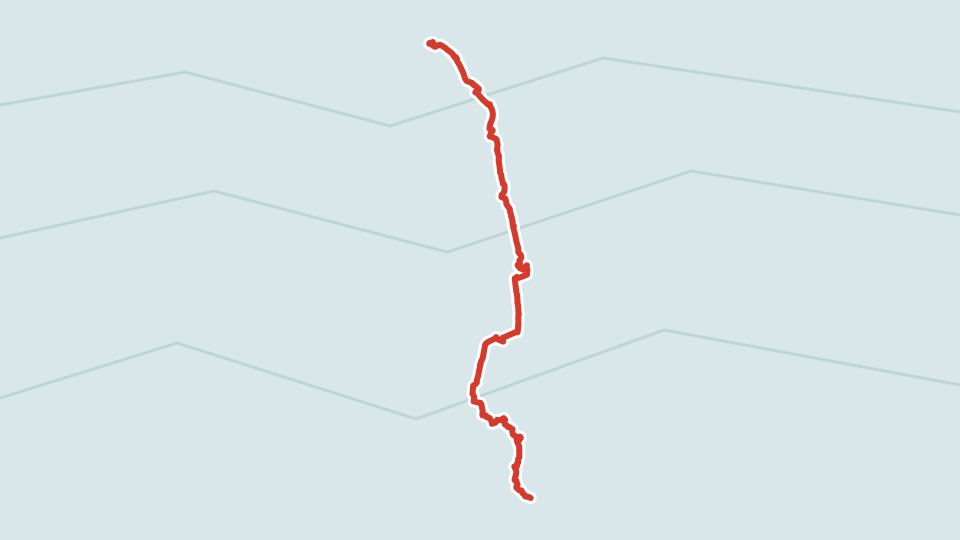
Even though I felt like I was coming down with something, skipping vacation wasn't an option. The next day I got dressed up, dragged my bike out through the narrow stairwell, and rode to the La Albufera nature park. It’s worth mentioning here that Spain, as we know, was under fascism until the '70s, and it developed slowly back then. Now, of course, new buildings have wide stairwells, bike storage, huge terraces, thermal insulation, and double glazing against noise and cold. In my friend's rented pad, the walls are a bit on the thin side, and I, being a noisy guy, probably bothered the neighbors. In all fairness, the kids at the stadium outside the window sometimes start their PE lessons right at eight in the morning, and they aren't shy about cranking up the boombox. More than once I woke up from their commotion, even though I sleep with earplugs.
Anyway, back to the bike ride. I rode out through the Turia (a park in a riverbed), passed the impossible buildings of the City of Arts and Sciences, and got onto the bike path along the sea leading to my destination.


La Albufera is a lake and freshwater lagoon just south of Valencia, separated from the Mediterranean Sea by a small strip of land. There is an incredible number of birds there, a nice super-long beach, and picnic spots. And now they've even built high-rises, so you can look straight at the sea from the balcony while sipping your morning Café con leche. As you can see, I've already picked up some Spanish words, although not that many. The ones that come to mind are tarjeta (card), bolsa (bag), Hola (somewhere between hi and good afternoon), gracias (thank you), Por favor (please), fresca (fresh), leche (milk), integral (whole grain), si (yes), no (no), perdon (excuse me), and others.
As for the park itself, it's practically flat, not even any hills, which is a rarity for Spain. This is handy if you weigh a ton like I do, but not very interesting. The park is perfect for bird lovers, but a bit on the boring side for bikers.


Some Huerta
They used to catch a fair bit of fish in the La Albufera park, now a bit less. They also grow rice. In general, basically everywhere in the region where there are no rocks and stones, there are fields and agriculture. This is no surprise, nearly 80% of the days in a year in Valencia are sunny. Everything probably grows like weeds (if you fertilize and water it).
There are problems with water, of course, but Valencia was once ruled by the cunning Moors. They came up with a clever system of canals that distributes water from the Turia River to everyone's plot. Right near the city itself lies a large chunk of fertile land called La Uerta (or Huerta, for those who miss my magnificent jokes).
The Tribunal de las Aguas de la Vega de la València, which has existed for over a thousand years, is the oldest continuously existing legal institution in the world. Eight elders, representatives of their communities, gather at noon by the cathedral on Thursdays to sort out disputes between farmers. They only argue about water, and in the Valencian language at that. The tribunal's decisions are swift, final, and not subject to appeal. Also, the locals strongly insist that Valencia is a "country", and Valencian is a "language", not a dialect of official Spanish (Castellano). Unlike Latgalian, the signs and street names are genuinely in Valencian, so there's a chance to preserve it for a while.


They grow peppers, tomatoes, carrots, cabbage, broad beans and various types of regular beans, artichokes, onions, and eggplants. All of this is fresh and gets sold to local restaurants or at the market. The restaurants make the Valencian version of paella. Valencians, of course, insist that paella was invented right here. Despite the size of the city, people in Valencia live slower than we do and try to enjoy the moment, which is why the "slow food" movement is popular here, where you eat without rushing.
As for my trip, there was another moment. I came across a car with a flashing light that was barely crawling along. The driver explained in broken English that there was a combine harvester driving behind him, and I needed to give way so I wouldn't get ground up. Very thoughtful! The thing is, pulling off the road isn't always possible — there are irrigation ditches or reeds on the sides.
I let the combine pass and rolled on. Soon I noticed bike route signs. If there's a sign, we go where it points! I rode up to a little hill with a temple of cats. Seriously, there's a church standing there, no people, just ten cats on different levels. The view of the surroundings is nice: even though it's just fields all around, at least there's a sense of space!


I got home by train from the Silla station.
Never Say Never to a Suma and a Kebabchik
I couldn't use my universal transport ticket, and had to buy a separate train ticket from the machine. Only later did I discover that paper tickets, although technically reusable, are much more finicky than the plastic ones. So I recommend buying a plastic one, even though it's a bit more expensive (two euros instead of one?).


The universal ticket is called SUMA , and it more or less lets you ride the metro, buses, trams, and commuter trains. Interestingly, in the metro, sometimes on the tram, and sometimes on the train, entry is through turnstiles, to "keep the honest folks honest" and stop people seeing off their friends from crowding the platform. On buses, the scanner is by the front door, which is where you have to get in — and the driver keeps an eye out to make sure you scan your ticket. I didn't see any ticket inspectors, but word is they're out there, and the fine is around 100 euros. Overall, the system works, but not perfectly. Like, the ticket comes in different types — for a single ride, for ten, for one day, two days, three days, or just loaded with money like a bank card. I still don't understand what's stopping all these transport agencies from just making machines that scan NFC in phones or bank cards, the way it was done ten years ago! in Ostrava, Czechia. I get that not everyone has cards, but nobody's stopping them from making a universal solution. The only hope is the EU, which keeps messing around with a universal electronic ID on the phone. Granted, we'll have to live long enough for the Brussels bureaucrats to finally give birth to something.
Be that as it may, I made it back successfully, and whipped up a dinner of whole-wheat pasta and some exceptionally stinky French cheese. My friend doesn't eat that kind of stuff, he eats tortillas that he calls kebabchiki. The recipe is perfectly simple: you smear the tortilla with sauce, put in some sliced ham, sliced cheese, maybe some greens or spices, fold it shut, and fry it just a tiny bit with a drop of oil. I try to be a health nut, so I still leaned heavily on my whole-grain rice with a vegetable salad. I added vegetarian patties of all sorts: made of soy, spinach, and beans. I also bought a dorado once, it was very tasty, even though it originally came from Greece. Then I bought some swordfish, it has an unconventional taste, doesn't even really smell like fish. It costs a million, so I'm happy with the dorado.

You only need to press the button once, but the pleasure will be constant!